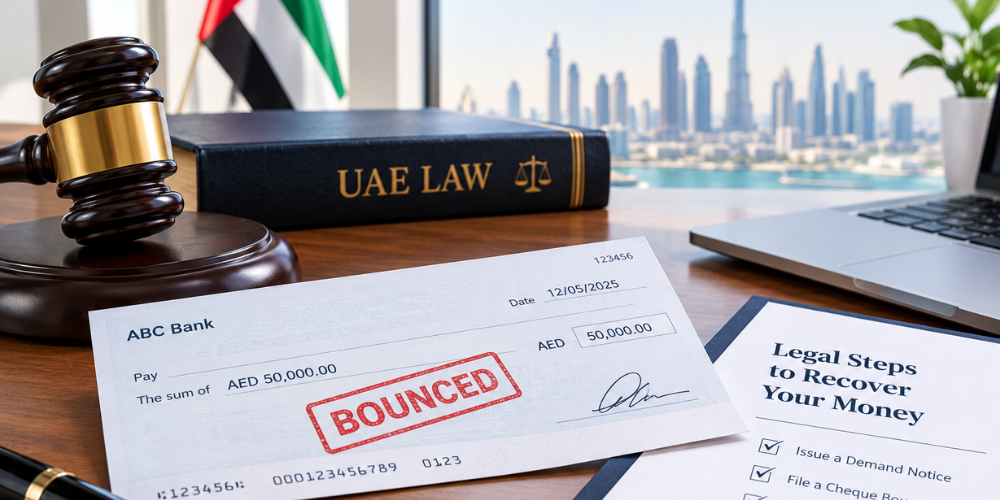
How to Recover Money From a Bounced Cheque in the UAE
Quick Answer
Since the 2022 reforms, a dishonoured cheque in the UAE is an executive instrument, which means the holder can take it straight to the Execution Court and enforce against the drawer's assets without a full separate trial. With the cheque and the bank return memo, the court can attach bank accounts, salary, property and vehicles. Where the drawer acted in bad faith, a criminal complaint may run in parallel.
Key points
- The cheque itself is enough to open execution; you do not first have to win a trial to prove the debt.
- You need the original cheque and the bank's return memo showing it was dishonoured.
- The Execution Court can freeze and attach the drawer's accounts, salary and assets.
- A travel ban can be sought against the drawer through the court to add pressure.
- Recovery speed depends mainly on how quickly the drawer's assets are located.
Being handed a cheque that bounces is frustrating, but in the UAE the law now gives the holder a fast route to recovery. Because a dishonoured cheque is treated as an executive instrument, you can move directly to enforcement rather than fighting a long lawsuit to establish the debt. This guide explains exactly how to turn a bounced cheque into recovered money, what you need, how assets are attached, and where the process can slow down.
If you are still unsure whether your situation is civil or criminal, start with our overview of bounced cheque law in the UAE, which explains when a cheque is still an offence. This guide assumes you now want to recover the money.
Why the cheque is your strongest asset
Before the reforms, a creditor often had to prove the underlying debt through ordinary litigation. Now the cheque does much of that work. As an executive instrument it is accepted by the Execution Court as proof of the obligation, so you can skip the trial stage that a normal debt claim requires and go straight to enforcing payment. That single change is what makes cheque recovery faster than most other forms of debt collection in the UAE.
What you need before filing
- The original cheque.
- The bank's return memo, confirming the cheque was dishonoured and the reason.
- Your identification, and for a company the trade licence and authorised signatory papers.
- Any contract, invoice or correspondence linking the cheque to the transaction, which is useful if the drawer disputes it.
The cheque and the return memo are the essentials. The supporting documents matter mainly if the drawer tries to challenge the cheque rather than simply lacking funds.
The recovery process step by step
- Present the cheque and obtain the return memo. The dishonour must be recorded by the bank; that memo is the trigger for enforcement.
- File at the Execution Court. The cheque is submitted as an executive instrument, and the court opens an execution file against the drawer.
- The drawer is notified and given a short period to pay. Many cases settle at this stage once the drawer sees enforcement is real.
- Assets are identified and attached. If payment is not made, the court can attach bank accounts, a portion of salary, property and vehicles registered to the drawer.
- A travel ban can be sought. Through the court, a ban may be imposed on the drawer, which often accelerates settlement.
- Funds are collected and released. Recovered amounts are paid out to satisfy the cheque.
Partial funds and the bank's duty
If the drawer's account holds some but not all of the amount, the bank is now required to pay out the available balance against the cheque. That partial payment reduces what remains to be recovered through execution, and the shortfall is pursued in the same way.
Where recovery slows down, and how to speed it up
The law gives you a fast start, but two things determine how quickly you actually get paid. The first is locating the drawer's assets, since the court can only attach what can be found. The second is whether the drawer contests the cheque or has genuinely no reachable assets in the UAE. Experienced representation helps on both fronts by identifying accounts and assets to target and by handling any challenge the drawer raises. Where the drawer has left the country, a UAE judgment or execution can sometimes be enforced abroad in states with reciprocal arrangements, including the GCC.
When the debt runs wider than the cheque, for example a supply relationship or a loan that produced several instruments, it may be more effective to combine cheque execution with a broader recovery strategy through our debt collection lawyers in Dubai. The general mechanics of enforcing any judgment, not just a cheque, are explained in our guide on how the Execution Court works in Dubai.
If the cheque was linked to rent or a contract
Cheques often secure rent or instalments under a contract. Where a tenant's rent cheque bounces, the landlord can pursue the cheque through execution while also filing at the Rental Disputes Centre, as covered in our guide on how to file a rental dispute in Dubai. Running the two together often produces a faster result than either alone.
Frequently asked questions
How do I recover money from a bounced cheque in Dubai?
Present the cheque and obtain the bank's return memo, then file at the Execution Court, where the cheque is enforced as an executive instrument. The court can attach the drawer's bank accounts, salary, property and vehicles to satisfy the amount.
Do I need to win a court case first before recovering a cheque?
No. Because a dishonoured cheque is an executive instrument, you can go directly to execution without first proving the debt in a full trial, which makes cheque recovery faster than ordinary debt claims.
What documents do I need to enforce a bounced cheque?
The original cheque and the bank's return memo are the essentials. Supporting documents such as the contract, invoice or correspondence help if the drawer disputes the cheque.
How fast is cheque execution in the UAE?
Execution can begin quickly once the file is opened, because there is no full trial stage. The overall timeline then depends mainly on how fast the drawer's assets are located and whether the cheque is contested.
Can I recover a cheque if the drawer has left the UAE?
Often yes. Any assets the drawer still holds in the UAE can be attached, and a UAE judgment or execution can sometimes be enforced abroad in countries with reciprocal arrangements, including the GCC states.
Speak to a Dubai cheque recovery lawyer
Rashid Al Suwaidi Advocates enforces dishonoured cheques through the Execution Court, attaching assets and pursuing settlement to get holders paid. To discuss recovery, contact the firm on +971 50 767 9696 or through our Emirati law firm in Dubai. For the full service, see our bounced cheque lawyers in Dubai and the UAE.
This article is general information about cheque recovery in the UAE and is not legal advice. Every matter turns on its own facts. For advice on a specific cheque, speak with a qualified advocate.