How to Enforce a Court Judgment in Dubai: The Execution Process
Quick Answer
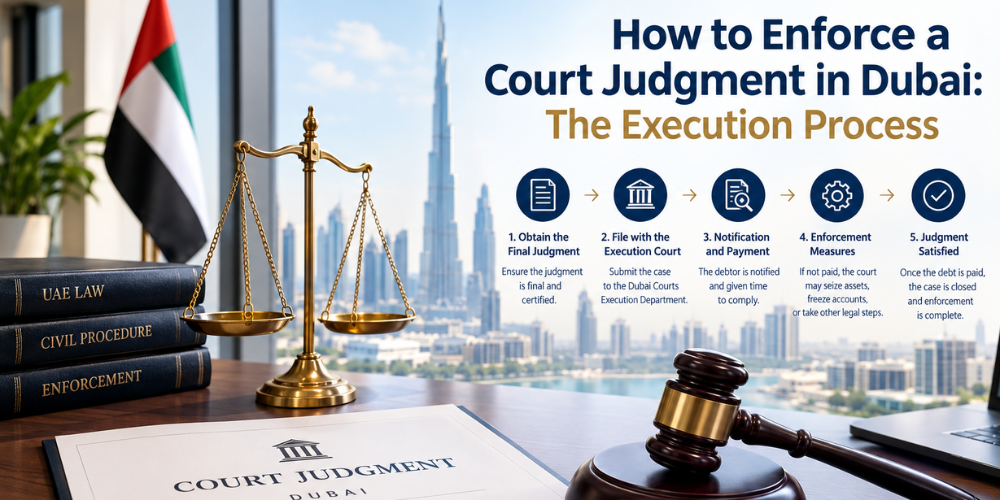
Winning a civil case in Dubai is only half the battle. To actually get paid, the judgment must be enforced through the Execution Court, which opens an execution file against the debtor and compels payment. Once the judgment is final and enforceable, the court can attach bank accounts, garnish a portion of salary, seize and auction property and vehicles, and impose a travel ban on the debtor. The debtor is first notified and given a short period to pay voluntarily.
Key points
- Enforcement runs through the Execution Court under the 2022 Civil Procedure Law.
- You need an enforceable instrument, usually a final judgment, ratified arbitral award or authenticated document.
- The court can attach bank accounts, salary, property and vehicles registered to the debtor.
- A travel ban can be imposed to pressure a reluctant debtor into settling.
- How fast you are paid depends mainly on locating the debtor's assets in the UAE.
A judgment in your favour is a piece of paper until it is enforced. In the UAE, enforcement is a separate stage handled by the Execution Court, and it is where many creditors either recover their money or discover how important preparation and strong representation are. This guide explains how the execution process works in Dubai, what the court can do to a debtor who will not pay, and where cases tend to stall.
The process here applies once you already hold an enforceable judgment. If you are earlier in the dispute and want to understand how a case reaches judgment in the first place, see our overview of how a civil case moves through the Dubai courts.
What counts as an enforceable instrument
The Execution Court does not re-try your dispute. It enforces an existing right that the law already treats as executable. The most common enforceable instruments are final court judgments, arbitral awards that have been ratified by the court, authenticated documents such as certain notarised agreements, and dishonoured cheques, which since the 2022 reforms can be taken straight to execution. Decisions of bodies such as the Rental Disputes Centre are also enforced through this route.
Because a cheque now enforces like a judgment, cheque holders can skip the trial stage entirely, as explained in our guide on how to recover money from a bounced cheque. For an ordinary debt with no cheque, you must first obtain a judgment and then move to execution.
Opening the execution file
Enforcement begins when the judgment creditor files an execution application with the competent court, submitting the enforceable instrument. The court opens an execution file against the debtor and issues a notice to pay. The debtor is given a short period set by the court to settle voluntarily. Many debtors pay or negotiate at this stage once they see that enforcement is real and that their assets are exposed.
What the Execution Court can do to a debtor who will not pay
If the debtor does not pay within the period given, the court has a wide range of enforcement measures:
- Attach bank accounts. The court can freeze and draw down the debtor's accounts to satisfy the judgment.
- Garnish salary. A portion of the debtor's monthly salary can be deducted at source and paid to the creditor.
- Seize and auction assets. Movable assets, vehicles and real estate registered to the debtor can be attached and sold, with the proceeds applied to the debt.
- Block dealings in property. The court can prevent the debtor from selling or transferring assets while the file is open.
- Impose a travel ban. A ban on the debtor leaving the country is a powerful lever that often brings a reluctant debtor to the table.
In limited circumstances the court can also order civil detention against a debtor who is able to pay but wilfully refuses. This does not apply where the debtor is genuinely unable to pay, and it is used as pressure rather than punishment.
Securing assets before the debtor moves them
A common problem is a debtor who empties accounts or transfers property once they sense a claim is coming. UAE law allows a creditor to apply for precautionary attachment, freezing specific assets before or during the case so that there is something left to enforce against at the end. Acting early, and identifying the right assets to target, is often the difference between a paper win and actual recovery. This is a core part of what a civil litigation lawyer in Dubai does when planning a claim.
Enforcing against a debtor who has left the UAE
If the debtor has assets remaining in the UAE, those can still be attached regardless of where the debtor is. Where the debtor and their assets are abroad, a UAE judgment can sometimes be recognised and enforced in another country, particularly within the GCC and other states that have reciprocal enforcement arrangements with the UAE. This is more complex and depends on the treaty position of the country involved.
Where enforcement slows down, and how to speed it up
The court can only attach assets it can find, so the single biggest factor in how quickly you are paid is asset tracing. A creditor who comes to execution with clear information about the debtor's banks, employer, vehicles and property will usually recover faster than one who files blind. The second factor is whether the debtor contests the enforcement or has structured their affairs to appear asset-poor. Experienced representation helps on both counts. Where the debt is commercial and spread across several parties or instruments, it is often more effective to combine execution with a wider strategy through our debt collection lawyers in Dubai.
Mind the time limits
Enforcement rights, like the underlying claims, are affected by limitation periods, and delay can weaken your position. Before you even reach judgment, the claim itself must be filed in time. Our guide on the time limits for filing a civil case in the UAE explains the periods that apply and why acting promptly protects both the claim and its enforcement.
Frequently asked questions
How do I enforce a court judgment in Dubai?
File an execution application with the competent court, submitting the final judgment. The court opens an execution file, notifies the debtor to pay within a short period, and if payment is not made it can attach bank accounts, salary, property and vehicles and impose a travel ban.
What is the Execution Court in Dubai?
The Execution Court is the stage of the court system that enforces judgments and other enforceable instruments. It does not re-hear the dispute; it compels the debtor to comply with a decision that has already been made.
Can the court freeze a debtor's bank account and salary?
Yes. The Execution Court can attach the debtor's bank accounts and garnish a portion of monthly salary, alongside seizing vehicles and real estate registered to the debtor.
Can a travel ban be imposed on someone who owes me money?
A travel ban can be sought through the court against a judgment debtor and is often effective at bringing a reluctant debtor to settle. Its availability depends on the nature of the debt and the court's discretion.
How long does execution take in Dubai?
Enforcement can begin quickly once the file is opened. The overall timeline then depends mainly on how fast the debtor's assets are located in the UAE and whether the debtor contests the process or has reachable assets at all.
Speak to a Dubai civil litigation lawyer
Rashid Al Suwaidi Advocates pursues enforcement through the Execution Court, tracing assets, obtaining attachments and travel bans, and driving reluctant debtors to settle. To discuss enforcing a judgment or securing assets, contact the firm on +971 50 767 9696 or through the website. For the full service, see our civil litigation lawyers in Dubai.