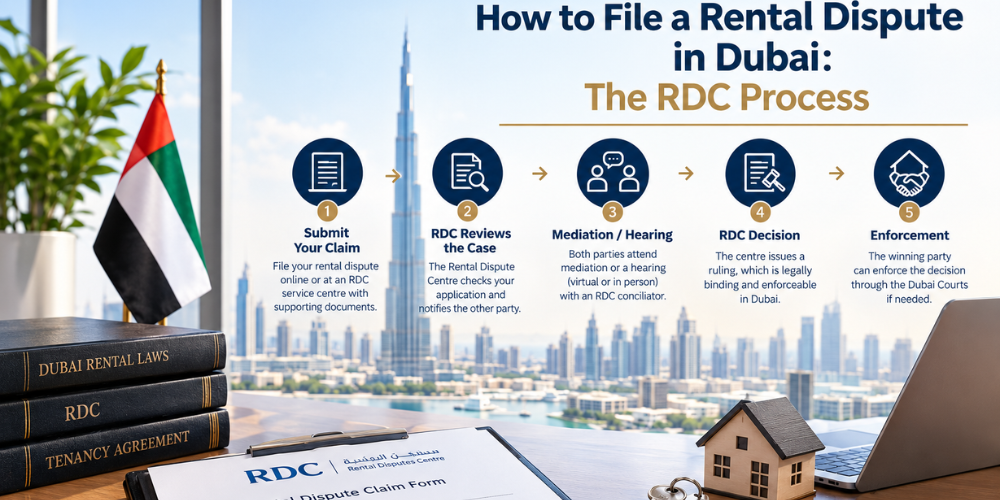
How to File a Rental Dispute in Dubai: The RDC Process
Quick Answer
Rental disputes in Dubai are not filed in the ordinary courts. They go to the Rental Disputes Centre (RDC), the judicial arm of the Dubai Land Department. You file online or in person with your tenancy contract, Ejari registration, Emirates ID, correspondence and payment records, and pay a fee based on the annual rent. The Centre attempts settlement first and, if that fails, a judge issues a decision, often at first instance within a few weeks.
Key points
- The RDC handles unpaid rent, unfair increases, eviction, deposit disputes and maintenance obligations.
- The tenancy usually must be registered through Ejari for the RDC to hear the case.
- The filing fee is typically 3.5% of the annual rent, subject to a minimum and maximum.
- Eviction for sale or personal use requires 12 months written notice through the notary public or registered mail.
- Overseas parties can be represented through a power of attorney without attending in person.
When a tenancy goes wrong in Dubai, whether it is unpaid rent, a deposit the landlord will not return, an increase above the legal cap or an eviction notice, the route to a decision is the Rental Disputes Centre rather than the civil courts. The Centre was built specifically for landlord and tenant matters and moves faster than ordinary litigation. This guide walks through who can file, what documents you need, the fees, the step by step process, and the notice rules that decide most eviction cases.
What the Rental Disputes Centre handles
The Rental Disputes Centre (RDC) is the judicial body of the Dubai Land Department that hears tenancy matters across the emirate. Typical cases include:
- Unpaid or late rent, and cheques that have been returned unpaid.
- Rent increases above the level permitted by the RERA index.
- Eviction, whether for sale, personal use or breach of the tenancy.
- Return of the security deposit and disputes over deductions.
- Maintenance and repair obligations, and early termination.
If your dispute is specifically about how much the rent can rise, read our companion guide on the RERA rental index and rent increase caps first, because the calculator result is often the single most important document in that type of case.
Before you file: the documents you need
A rental claim is largely documentary, so preparation decides how smoothly it runs. Gather:
- The signed tenancy contract.
- The Ejari registration certificate.
- Your Emirates ID, and passport and visa copies.
- Proof of payments, such as cheques, receipts or bank transfers.
- All correspondence with the landlord or tenant, including any notices served.
- For a company, the trade licence and authorised signatory documents.
The Ejari registration matters in particular. As a general rule the tenancy must be registered through Ejari for the RDC to hear the case, so an unregistered tenancy should be addressed before or alongside filing.
The filing fee
The RDC charges a filing fee calculated as a percentage of the annual rent, typically in the region of 3.5%, subject to a minimum and a maximum. There are smaller additional charges for services such as translation, expert referral and knowledge fees. The exact total depends on the rent and the type of claim, and it is worth confirming the figure before filing so there are no surprises.
The step by step process
- Register and submit the claim. Cases can be filed through the DLD channels online or in person. You lodge the claim details, upload the documents and pay the fee.
- The defendant is notified. The other party is served and given the chance to respond.
- Conciliation is attempted. The Centre first tries to settle the matter through its reconciliation stage, which resolves many disputes without a full hearing.
- The case is heard. If settlement fails, the file passes to a judge, memoranda and evidence are exchanged, and a first instance judgment is issued, frequently within a few weeks for a straightforward claim.
- Appeal, where available. Depending on the value and nature of the claim, a party may appeal within the set period.
- Execution. A final judgment moves to enforcement, where sums can be recovered or an eviction carried out.
Eviction: the notice rules that decide the case
Eviction is where tenants most often have rights they do not realise, and where landlords most often lose on procedure. For eviction on grounds of sale of the property or use by the owner or a close relative, the law requires 12 months written notice, served through the notary public or by registered mail. A notice that misses the method or the period is routinely dismissed.
Eviction during the term of a tenancy is different and available only on specific grounds, such as non payment after a formal warning, illegal use of the premises, or subletting without consent. A landlord cannot simply refuse to renew and change the locks. Where an eviction notice arrives alongside a rent demand, treat them as separate issues: the increase is limited by the index, and the eviction stands or falls on the notice.
Do you need to be in the UAE?
No. A landlord or tenant who is abroad can be represented throughout by an advocate acting under a power of attorney, covering filing, hearings and execution. This is common for overseas owners of Dubai property and for tenants who have already left the country but are still owed a deposit.
Where a lawyer changes the outcome
Many small rental claims can be filed without representation. The cases where legal help pays for itself are contested evictions, disputes over large deposits or fit out costs, claims tangled up with unpaid cheques, and any matter where the other side has a lawyer. A rental dispute lawyer in Dubai prepares the claim so nothing is rejected on a technicality, argues the notice and index points that decide most cases, and carries the matter through to execution. Where unpaid rent was secured by cheques that later bounced, the claim can run in parallel with recovery on the cheque itself, which we explain in our guide on how to recover money from a bounced cheque. Property owners weighing a sale or a wider ownership dispute alongside the tenancy can also speak to our real estate lawyers in Dubai.
Frequently asked questions
How do I file a rental dispute in Dubai?
File at the Rental Disputes Centre, the judicial body of the Dubai Land Department, online or in person, with your tenancy contract, Ejari registration, Emirates ID, payment records and correspondence, and pay the filing fee. The Centre attempts settlement first, then refers the case to a judge if needed.
How much does it cost to file a case at the Rental Disputes Centre?
The fee is typically around 3.5% of the annual rent, subject to a minimum and maximum, with smaller additional charges for services such as translation and expert referral. Confirm the exact figure for your claim before filing.
How long does a rental dispute take in Dubai?
A straightforward first instance case is often decided within a few weeks, helped by the conciliation stage. Contested matters and appeals take longer, and execution depends on how quickly the judgment can be enforced.
How much notice does a landlord need to evict a tenant in Dubai?
Eviction for sale of the property or personal use requires 12 months written notice served through the notary public or registered mail. Notices that miss the method or the period are routinely dismissed at the RDC.
Do I have to be in the UAE to file a rental dispute?
No. A landlord or tenant abroad can appoint an advocate under a power of attorney to file the claim, attend hearings and handle execution without being present in the country.
Speak to a Dubai rental dispute lawyer
Rashid Al Suwaidi Advocates acts for landlords and tenants in unpaid rent, eviction, deposit and rent increase cases before the Rental Disputes Centre, from filing through to execution. To discuss a matter, contact the firm on +971 50 767 9696 or through the website.
This article is general information about the rental dispute process in Dubai and is not legal advice. Every tenancy turns on its own facts and documents. For advice on a specific dispute, speak with a qualified advocate.