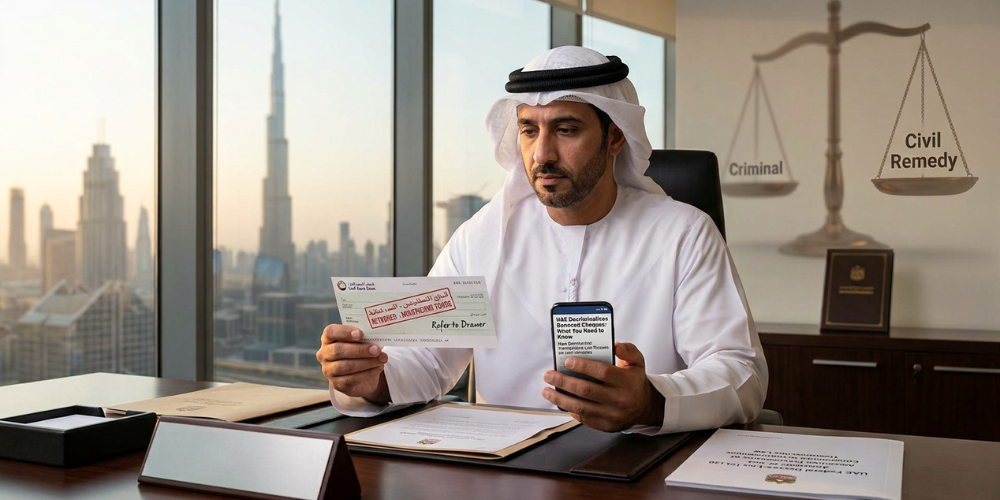
Bounced Cheque in the UAE: Is It Still a Crime?
Quick Answer
For most cases of insufficient funds, a bounced cheque in the UAE is no longer a crime. Since 2 January 2022, a cheque returned for lack of funds is treated mainly as a civil and execution matter, and the cheque itself acts as an instrument the holder can enforce directly. Criminal liability now applies only to bad faith conduct, such as stopping payment without lawful cause, closing the account before the cheque is presented, or signing so the cheque cannot be honoured.
Key points
- Genuine inability to pay is not a crime after the 2022 reforms.
- The cheque now functions as an executive instrument, so the holder can go straight to the Execution Court.
- Where funds are partly available, the bank must pay out the available balance against the cheque.
- Criminal liability remains for fraud and deliberate bad faith conduct.
- The debt behind the cheque stays fully enforceable either way, so early action matters.
Few areas of UAE law have changed as sharply as the treatment of bounced cheques. For years a returned cheque meant a police complaint and the risk of a criminal record. The reforms that took effect on 2 January 2022 rewrote that position, shifting most cheque matters from the criminal track to civil recovery. If you have received a cheque that bounced, or issued one you could not honour, the rules that now apply are very different from what many people still assume. This guide explains what changed, when a cheque is still a crime, and what to do on either side.
What changed on 2 January 2022
The central change is that a cheque returned for insufficient funds is no longer automatically a criminal offence. Instead, the cheque is treated primarily as a civil and execution matter. Three practical consequences follow:
- The cheque is an executive instrument. The holder can proceed directly to the Execution Court to recover the amount, without first running a full separate trial to prove the debt.
- Partial payment is mandatory. Where some funds are available in the account, the bank is required to pay out the available balance against the cheque, rather than returning it wholly unpaid.
- The focus moves to recovery. The system now prioritises getting the holder paid over punishing the drawer, which usually serves the creditor better.
When a bounced cheque is still a crime
Decriminalisation is not absolute. Criminal liability remains where the conduct goes beyond simply not having the funds and into bad faith. Examples include:
- Ordering the bank to stop payment on the cheque without a lawful reason.
- Closing the account, or withdrawing the balance, before the cheque is presented so that it cannot be honoured.
- Deliberately signing the cheque in a way that does not match the specimen, so the bank must reject it.
- Issuing a cheque as part of a fraud.
The line is intent. An honest business that runs short of cash faces a civil claim; a person who manipulates the account or the signature to defeat the cheque faces a criminal one. Where fraud is involved, the matter is handled by our criminal lawyers in Dubai.
If you are holding a bounced cheque
The reform generally works in your favour, because it lets you move straight to enforcement. In outline:
- Ask the bank for the return memo confirming the cheque was dishonoured and the reason.
- Where the drawer acted in bad faith, a criminal complaint may still be available in parallel.
- Otherwise, take the cheque to execution, where the drawer's accounts, salary and assets can be attached to satisfy the amount.
The mechanics of enforcing the cheque, and how quickly funds can be recovered, are set out in detail in our guide on how to recover money from a bounced cheque.
If you issued a cheque you cannot honour
The change removes the automatic risk of prison for honest default, but it does not make the debt disappear. The holder can still enforce against your assets and, through the court, seek a travel ban. The right response is to act before enforcement rather than after:
- Contact the holder early. Payees frequently accept a structured settlement, often with penalties or interest waived, rather than chase execution.
- Do not close the account or stop the cheque, which can convert a civil problem into a criminal one.
- Take advice on your overall exposure, since a bounced cheque often sits alongside loans and card debt.
Cheque trouble rarely arrives on its own. It commonly comes with bank facilities, personal guarantees and the risk of a travel ban, which we cover in our guide on credit card default in the UAE, and defend through our debt defence lawyers in Dubai.
Cheques and travel bans
A travel ban is not automatic on a bounced cheque. A creditor must apply for one through the court, usually after filing, and it can be lifted through settlement or by court order once the underlying claim is resolved. If you are unsure whether a ban already exists against you, our guide on how to check a travel ban in the UAE explains the ways to verify it before you travel.
Frequently asked questions
Is a bounced cheque a crime in the UAE?
In most cases of insufficient funds, no. Since 2 January 2022 a bounced cheque is treated mainly as a civil and execution matter. Criminal liability remains only for bad faith conduct such as stopping payment without cause, closing the account before presentation, or fraud.
What happens if I cannot pay a cheque I issued in the UAE?
The debt stays enforceable and the holder can go to execution against your assets and seek a travel ban, but honest inability to pay is not a crime. Approached early through a lawyer, payees routinely accept structured settlements with penalties waived.
Does the bank have to pay part of a bounced cheque?
Yes. Under the reforms, where funds are partly available the bank is required to pay out the available balance against the cheque rather than returning it entirely unpaid.
Can I still be jailed for a bounced cheque?
Only in limited bad faith cases, such as deliberately stopping the cheque, closing the account to defeat it, mismatching the signature, or issuing it as part of a fraud. A genuine shortfall of funds is a civil matter.
Will a bounced cheque lead to a travel ban?
Not automatically. A creditor must obtain a travel ban through the court, and it can be lifted by settlement or court order once the claim is resolved.
Speak to a Dubai cheque lawyer
Rashid Al Suwaidi Advocates acts for both holders enforcing dishonoured cheques and drawers defending or settling them, across Dubai and the UAE. To discuss a cheque matter, contact the firm on +971 50 767 9696 or through the website. For the full service, see our bounced cheque lawyers in Dubai and the UAE.